Roofing over farmyards in South Wales
A roof over a feed yard, a collecting yard or a muck store keeps the rain clean. That is less dirty water to store and spread, drier stock and feed, and — for three kinds of yard — a Welsh Government grant of £40 for every square metre roofed.
- Rain it keeps clean
- 1 m³ per m²
- For every metre of rain a year. That is water you no longer store or spread.
- Welsh Government grant
- £40 per m²
- £3,000 to £15,000 a year, for three kinds of yard.
- SAB threshold
- 100 m²
- Most yard roofs are over it. Start early.
- What it stands on
- Its own pads
- Not the yard walls. The engineer sizes them.
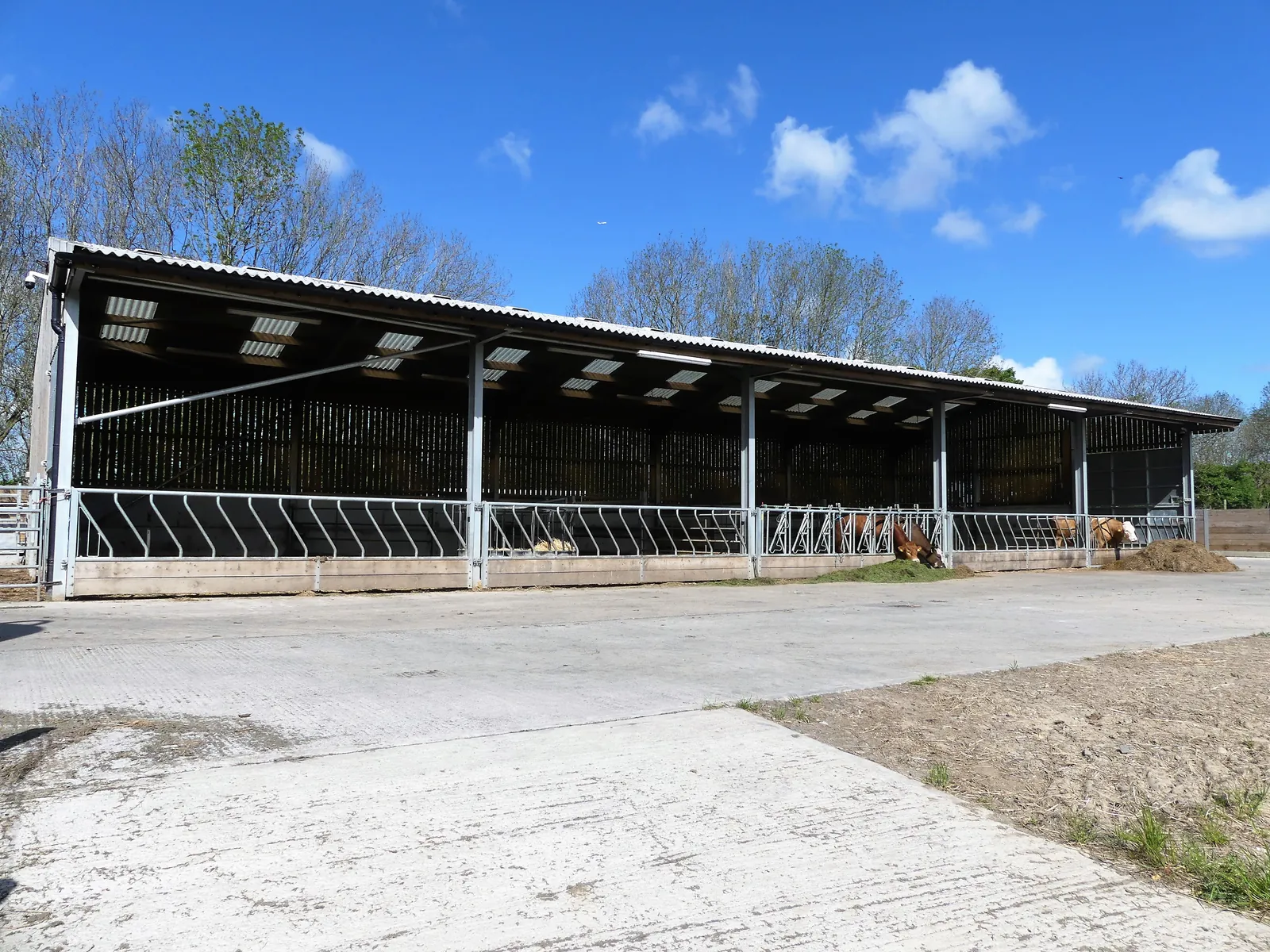
Why roof a yard
Rain that lands on a dirty yard does not stay rainwater. It picks up muck and feed, becomes dirty water, and from then on it is part of the slurry: it has to be collected, held in the store and spread on the land under the Water Resources (Control of Agricultural Pollution) (Wales) Regulations 2021. Roof the yard and the same rain comes off the roof clean, down the gutters and away to a clean water drain.
375 m³
Take a 250 m² feed yard in a year with 1,500 mm of rain. Left open, that is 375 m³ of dirty water — about 35 loads in an 11 m³ tanker. Roofed, it is none.
That is store capacity you get back without digging, spreading days you no longer need in the wettest months, and less water carrying nutrients off the fields. The feed stays drier at the barrier, the yard is less of a mire in January, and stock stand in less of it.
The arithmetic is simple enough to do for your own yard: its area in square metres, times your annual rainfall in metres, is the cubic metres of dirty water it makes.
The yards the grant covers
Any yard can be roofed. Three kinds, if they are in use now, qualify for the Welsh Government's Small Infrastructure grant:
- Livestock feeding area. A permanent feeding area, enclosed by walls or permanent barriers, used through the winter feeding period.
- Livestock gathering area. A permanent gathering area with a demonstrable purpose, such as a collecting yard for the parlour or access to a fixed handling system.
- Solid manure store. A store for farmyard manure that stacks without slumping — not slurry — with impermeable wall bases.
Each needs a sound concrete floor already, must not be roofed now and must not have been grant funded before. A 250 m² feed yard that meets the rules earns £10,000. The yard roofing grant calculator checks each of your areas against the rules and lists what you would need to do.
Designing the roof
What it stands on
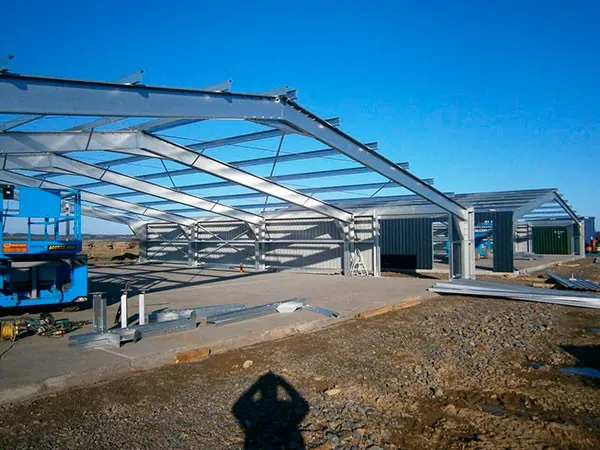
A steel portal frame carries the roof down through its stanchions, and each stanchion stands on a concrete pad sized by the structural engineer. On an existing yard that means breaking out the concrete where each pad goes and making good around it afterwards. The yard walls are not the foundation: they were built to hold stock and muck, not a roof that the wind is trying to lift.
The pads, the breaking out and the making good are groundworks, and they are yours to arrange. South West Steel Buildings' design gives the pad sizes and the positions of the holding-down bolts, which is what your groundworker works to.
Height
Set the eaves by the tallest job under the roof: a loader at full lift, a tipping trailer, the feeder wagon. Measure the machine. Higher than that lets more driving rain in under an open side, so the right height is enough for the work and no more.
Sides, or not
Most yard roofs are open, or clad on the weather side only, with space boarding or sheeting partway down. Air moves through, stock stay cool, and the roof does its job of keeping the rain off the concrete. Every side you clad catches wind, and wind is what the frame and pads are designed for, so the sides are decided at the start, not added later.
Where the water goes
The whole point is the clean water, so the gutters and downpipes matter as much as the roof. They take the rain to a clean water drain or to rainwater harvesting and never into the dirty water system. If the dirty water under the roof is going to a new reception pit or store, Natural Resources Wales needs 14 days' written notice before you build it.
The standard it is built to
For the grant the roof must be built to BS 5502 Part 22:2013, the British Standard for agricultural buildings, CE marked or backed by structural calculations from a qualified engineer, with no second-hand materials. South West Steel Buildings design and supply the frame with the calculation pack that shows it, then erect it.
Planning and SAB
Two consents, both from your council. Planning: a yard roof is often agricultural permitted development, which in Wales usually still means a prior notification before you build. Welsh rules are not England's, so check what your council needs for your roof.
SAB: any construction in Wales with a construction area of 100 m² or more needs SuDS Approval Body approval before work starts, and farm roofs are included. Most yard roofs are over that size. Welsh Government publishes advice notes on SAB for farm buildings, coverings and clean yards. Both take weeks, so start them while the design is being drawn.
If you are going for the grant
- 1
Measure and photograph
Each area you want roofed, with geo-tagged photographs before anything changes.
- 2
Check it and get a price
Run your areas through the grant calculator, then send them to us for a price. Pricing before the award is fine.
- 3
Apply through RPW Online
You apply yourself. The calculator page has the selection dates.
- 4
Wait for the award letter
Order nothing, pay no deposit and start nothing until it arrives.
- 5
Build and claim
Planning and SAB evidence, the roof built to BS 5502 Part 22:2013, then claim. Keep the roof in use for 5 years.
Questions
Does roofing a yard reduce the amount of slurry?
Yes, by the rain it keeps off. Rain that falls on a dirty open yard becomes dirty water, and has to be collected, stored and spread with the slurry. Rain that falls on a roof stays clean and goes to a clean water drain. Every square metre of yard roofed keeps one cubic metre of water out of the store for every metre of rain that falls in a year, which on a wet holding is often the difference between a store that copes through the winter and one that does not.
Can a yard roof sit on the existing yard walls?
Usually not. A portal frame puts its loads down through the stanchions, including wind trying to lift the roof, and a yard wall was built to hold back stock and muck, not to carry a roof. The stanchions normally stand on their own concrete pads, which means breaking out the yard concrete at each one and reinstating it afterwards. Whether any existing wall can play a part is a question for the structural design, not something to assume.
How high should a yard roof be?
High enough for the tallest thing that works under it, with the loader bucket or trailer body at its highest, plus a margin. That usually sets the eaves height, and it is worth measuring the machine rather than guessing. Going higher than you need lets more driving rain in under the eaves on an open-sided roof, so there is a balance: clearance for the work, and as little height as that allows.
Should a yard roof have sides?
Most are open-sided, or clad only on the weather side, with space boarding or sheeting down to a height that keeps the worst of the rain out while letting air move. Every side you clad catches wind, which changes the loads the frame and the pads are designed for, so it is decided at the design stage rather than added later. If the roof is going for the Welsh Government grant, remember it must not become livestock housing once it is roofed.
Is there a grant for roofing a cattle yard in Wales?
Yes. The Welsh Government's Small Infrastructure grant pays £40 per square metre for a new roof over an existing livestock feeding area, livestock gathering area or solid manure store, from £3,000 to £15,000 a year per CRN. Nothing can be ordered before the Grant Award Letter arrives. The calculator on this site checks each area against the rules and works out the grant.
Do I need planning permission to roof a yard in Wales?
Often a yard roof is agricultural permitted development, which in Wales usually still means a prior notification to the council before you build. It also needs approval from the SuDS Approval Body if the construction area is 100 m² or more, which most yard roofs are. Ask your council about both before you commit; the grant claim needs evidence of each.
Grant figures from the Welsh Government's Small Infrastructure scheme, as set out on the grant calculator page, where the sources and the date they were checked are listed.
Get the roof over your yard priced
Send us the yard's size and what it is used for and South West Steel Buildings will design and price the roof, with the pad sizes your groundworker needs.